Precancels Canada and commercial overprints Great Britain

A Collector's Guide to Canadian Pre-cancelled Stamps
What Are Pre-cancels?
Canadian Pre-cancelled stamps (often called "Précancels") are postage stamps that were cancelled before
being used for mailing. They feature a printed or handstamped overprint that includes a place name (and
sometimes a design or serial number), allowing them to bypass the normal cancellation process at the post
office. This was an efficiency measure for bulk mailings from businesses, newspapers, and organizations.
Historical Overview
Period of Main Use: 1893 to the 1980s, with peak usage in the mid-20th century.
Purpose: To expedite the handling of large-volume mail. Since the stamps were already "cancelled," postal
clerks did not need to hand-cancel each piece, saving significant time.
Decline: The system was largely replaced by postage meters and permit mail (bulk mailing imprints) in the
latter part of the 20th century.
The Two Main Types of Pre-cancels
1. Bureau Print (Bureau-Précis)
- Professionally printed by the Canadian Bank Note Company in Ottawa.
- Uniform, neat in appearance.
- Usually printed in black or red ink.
- Sold in sheets to large-volume mailers.
2. Local Print (Précancels Locaux)
- Applied at the local post office or by businesses using their own methods.
- Much more varied and irregular.
- Methods included: rubber handstamps, typewriter impressions, typographical overprints.
- These are often the most interesting to specialists due to their varieties and errors.
Key Series and Identifying Features
- Early Period (1890s-1920s): Often crude local handstamps or simple overprints. Rare and highly collectible.
- " Numeral Types" (1922-1929): A famous and highly specialized series. The overprint consists of a
serial number between two horizontal bars.
- Type I: Thick numerals, usually in red.
- Type II: Thinner numerals, usually in black.
- Many sub-types exist based on font and dimensions.
- "Town Mark" Types (1930s-1950s): Overprints featuring the place name within a double-circle, oval, or other frame (e.g., "WINNIPEG - MAN.").
- Base Stamps: Pre-cancels were applied to Canada's regular definitive issues (like the Medallion series, Wildlife series, and monarch portraits).
Collecting and Cataloging
The Standard Reference:
The "Steele's Catalogue of Canadian Pre-cancels" is the essential guide. It catalogs stamps by:
- The base stamp design.
- The overprint type (Bureau or Local, font, style).
- The town or city name.
How to Specialize:
Collectors often focus on:
- A specific province or town.
- A particular overprint type (e.g., only Numeral Types).
- A specific time period or base stamp series.
Value and Market Notes
- Common vs. Rare: Many pre-cancels, especially from major cities, are common and inexpensive. Value increases significantly with rarity.
- Key Factors Influencing Value:
- Scarcity of the combination (a specific town on a specific stamp).
- Condition: Mint never-hinged (MNH) examples are generally more valuable than used, though "mint" is a less logical state for a pre-cancelled stamp.
- Errors: Double overprints, inverted overprints, wrong ink color.
- Complete Sets: A collection of all known towns for a given stamp type.
- Local prints from small towns are often rarer than those from large cities.
Research Tips for Online Collectors
- Primary Online Resource: The Precancel Collectors Club of Canada (PCCC) website (precancel.ca)
offers town lists, images, and identification guides.
- Canada precancel
- Canada precancel numeral
- Canada precancel [Town Name]
- Steele's B3 (using a specific catalog number)
- Study Listings: Serious sellers often include the Steele's catalog number (SC#) in their descriptions. Note these codes for your research.
- Join the Community: Engage with forums like the Stamp Community Family (Canadian section) for expert help and discussion.
A Note on Modern Times
Canada Post no longer issues new pre-cancelled stamps in the traditional sense. The era effectively
ended
with the dominance of postage meters and electronic postage.
This makes pre-cancels a defined and complete field of postal history, perfect for systematic
collection.
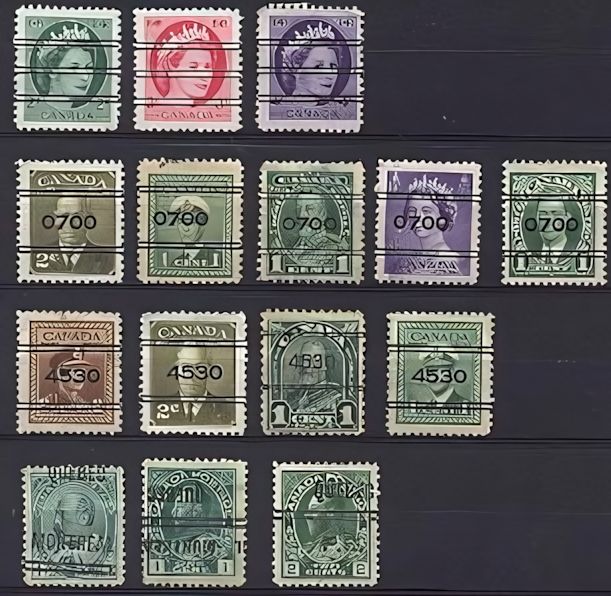
Example precancels Canada
Commercial overprints Great Britain
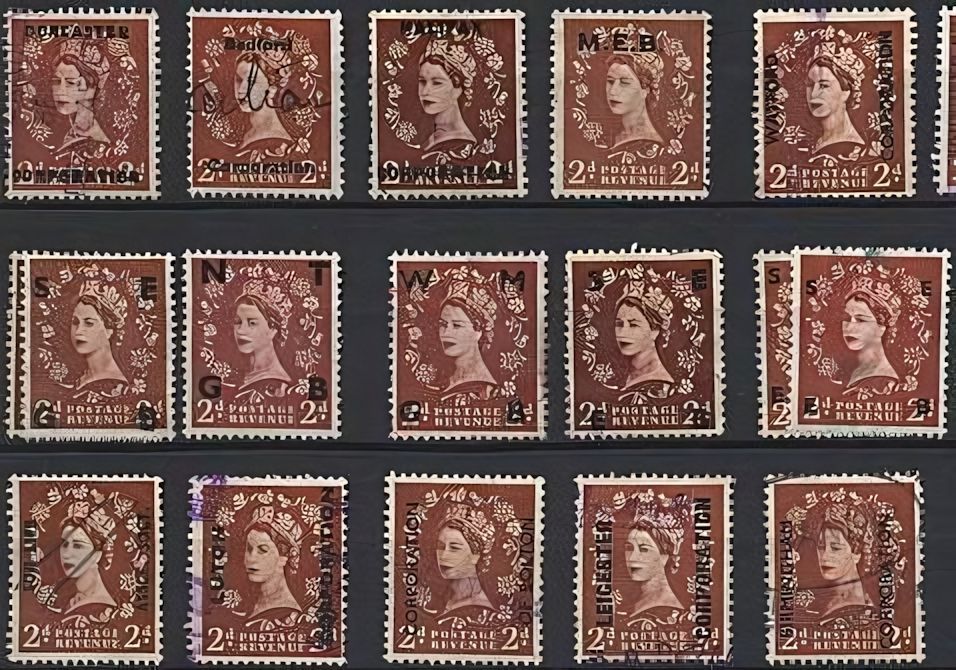
These stamps are (not) real precancels. They are for revenue purposes only not valid for postage. At the time all receipts, checks etc attracted a duty of 2d. Some had these pre-printed on the documents but others were validated by the use of 2d postage "&" REVENUE stamps. The ones here are mainly from utilities (Gas Electricity,water supply etc) and have obviously been removed from the documents concerned. They are not particularly valuable but are quite interesting. On the original documents ( other than ordinary receipts) they can have social history interest.
A Collector's Guide to Great Britain's "Commercial Overprints"
What Are Commercial Overprints?
Great Britain's Commercial Overprints (often called "Private Overprints" or "Advertisement Overprints")
represent a unique and fascinating niche in British philately. They are regular postage stamps that were
privately overprinted by businesses, organizations, or event promoters with an advertisement or slogan.
Unlike official postage due or fiscal stamps, these were created for promotional purposes and were valid for
postage. Their primary goal was to catch the recipient's eye, turning everyday mail into a miniature
advertising billboard.
Historical Context and Legal Status
- The Golden Era: Circa 1890s to the 1930s. This practice flourished before strict postal regulations and modern advertising methods took hold.
- Legal Grey Area: Initially, the British Post Office had no explicit regulations against it, provided the overprint did not obscure the monarch's portrait or the stamp's value. It was a tolerated practice until the Post Office began to assert more control, eventually deeming it an improper "defacement" of the King's/Queen's effigy.
- The "Castle" Ruling: A key turning point was the 1934 case of Castle's Ltd., a London clothing retailer. The Postmaster General took them to court over their advertising overprints. While the initial ruling favored Castle's, the Post Office subsequently revised its regulations to effectively ban new commercial overprints, ending the main era of their creation.
Types and Themes of Overprints
The variety is immense, reflecting the commercial and social life of the era. Major categories include:
1. Business Advertisements
- Retailers: Department stores (e.g., Army and Navy Stores), tailors, tobacconists, tea merchants.
- Products: Early brands of soap, cocoa, tires, and beverages.
- Services: Shipping lines, insurance companies, hotels.
2. Event and Exhibition Publicity
- Exhibitions: Overprints promoting major events like the British Empire Exhibition (1924-25) at Wembley are classic and highly collectible.
- Sporting Events: Football matches, horse races, regattas.
- Cultural Events: Theatre productions, musical performances.
3. Political and Social Messages
- Less common, but examples exist for causes like "Buy British" campaigns or charitable appeals.
Collecting Focus: Rarity, Condition, and "Cinderella" Status
British commercial overprints are generally considered "Cinderella" stamps (not official government-issued postage). This shapes their market:
- Rarity is Paramount: Many were produced in very small quantities for a local business or short-lived campaign. Rarity is not determined by age alone, but by survival rate and demand.
- Condition is Critical: Collectors seek stamps with clear, complete, and centered overprints. The underlying stamp should also be in fine condition (well-centered, fresh colour, good perforations). A faint, partial, or smudged overprint drastically reduces value.
- On-Cover vs. Off-Paper: Stamps still affixed to their original envelope (on cover) are the ultimate prize. They provide full postal history context—proving genuine usage, showing the postmark date, and often revealing the nature of the business that used them. Off-paper singles are more common.
- The "Bogus" Problem: This field has reproductions and outright fakes. Knowledge is essential. Provenance (a documented history from a reputable auction or collection) adds significant value.
Key Catalogs and Resources
There is no single universally accepted catalog like Stanley Gibbons for these issues. Research relies on specialized literature:
- The Essential Guide: "Great Britain Private Overprints on Postage Stamps" by John Parmenter. This is the foundational reference, attempting to catalog and illustrate known overprints.
- Online Resources
My social media pages:

|

|

|

|